How Often Should Solar Panels Be Serviced? A UK Guide
Solar PV is famously low-maintenance, but "low" isn't "none" — here's exactly how often a UK system needs servicing, what that service covers and what it should cost.
The short answer: how often a UK solar system needs servicing
For a typical Wiltshire home, the sensible rhythm is a full professional solar PV service every 12 months, a clean every 12 to 18 months, and a quick glance at your monitoring app once a month. That combination catches almost every problem before it costs you generation.
This is deliberately more frequent than the bare minimum some installers quote (a visual check annually, a clean every one to three years, a deep service every five). The reason is simple economics. A 4kWp system in our region generates around 3,900 kWh a year and saves roughly £950–£1,100 against a 27p unit rate. If a quietly failing inverter or a soiled array shaves 10% off output for eighteen months before anyone notices, you have lost more than a decade of service fees in missed savings and Smart Export Guarantee income.
The frequency also depends on your site. Panels under or near trees, beside a bird roost, or close to a dusty farm track or coastal road soil faster and benefit from cleaning every six to nine months. Open, rain-washed roofs on a gentle pitch stay cleaner for longer. The honest position is that solar PV is genuinely low-maintenance — but "low" is not "none", and the systems that quietly underperform for years are almost always the ones nobody ever looked at.
What a proper solar panel service actually covers
Good solar panel maintenance is not just someone wiping the glass. A genuine annual service is an electrical and mechanical inspection by a qualified engineer. At Lumos Energy our employed team — not subcontractors — works through a fixed checklist on every visit.
| Area | What gets checked | Why it matters |
|---|---|---|
| Panels & mounting | Cracks, delamination, hot spots, clamp torque, roof penetrations | Loose clamps and failed seals cause leaks and slipped panels |
| Inverter | Fault logs, fan/airflow, firmware version, output vs expected | The inverter is the single most common failure point |
| DC & AC wiring | Connector integrity, insulation resistance, isolator condition | High-resistance DC connections are a real fire risk |
| Isolators & protection | DC/AC isolator operation, RCD/breaker function, earthing | Degraded isolators fail dangerously and silently |
| Monitoring | Data accuracy, alert setup, year-on-year comparison | Confirms the system is actually performing, not just "on" |
You should receive a written report afterwards listing readings, any defects and recommended actions. Keep these reports — many manufacturer extended warranties and your installer's workmanship guarantee require evidence of regular professional maintenance, and a claim can be refused if you cannot show the system was looked after. That paper trail is part of good solar panel installation Wiltshire aftercare, not an optional extra.
Cleaning, monitoring and the jobs in between services
Between annual services, two ongoing tasks keep a system healthy: cleaning and monitoring.
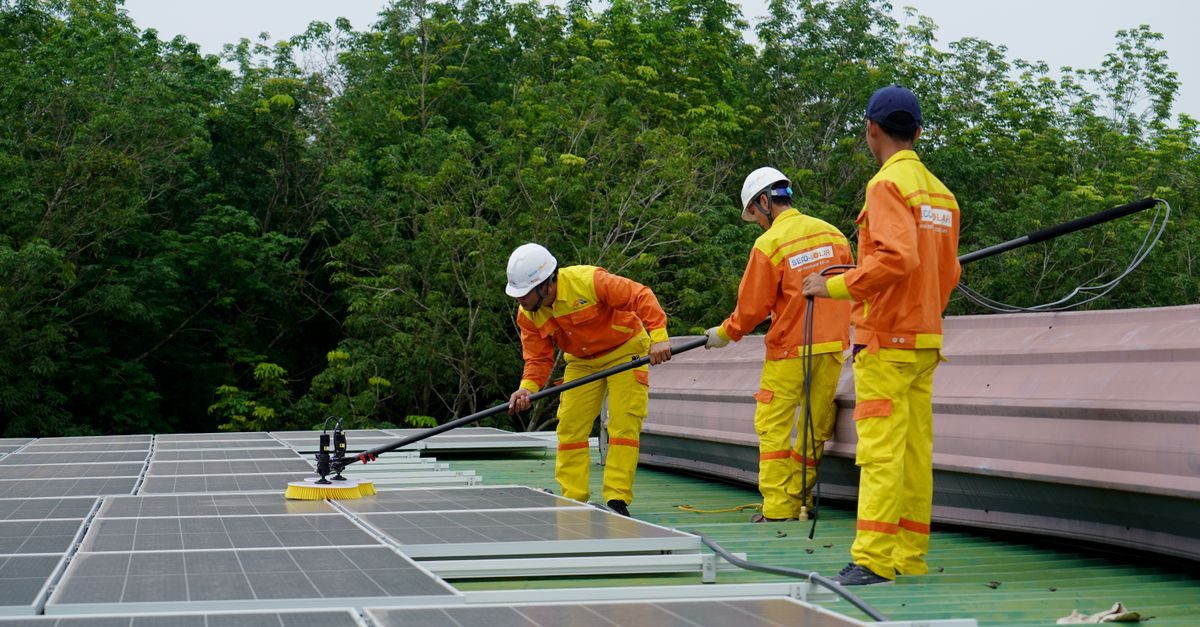
Cleaning. UK rain does most of the work, but it does not shift bird droppings, lichen, pollen film, moss creeping from a ridge, or the greasy dust that settles near busy roads. Soiling typically costs 5–10% of output, rising toward 25% with heavy localised dirt such as a single panel under a guttering drip. Professional cleaning uses purified water and a telescopic brush from the ground — never abrasive pads, jet washers or household detergents, which scratch the anti-reflective coating and can void the warranty.
Monitoring. This is the cheapest, most powerful maintenance habit you have and it is free. Open your inverter or battery app once a month and compare this month's generation against the same month last year. A 5% or greater year-on-year drop, an inverter showing a fault code, or one string consistently lower than its twin all warrant a call. Monitoring is what catches a dying inverter in week two rather than month eighteen.
If you have added storage, the same discipline applies to the battery — see our Sigenergy battery review for how modern units self-report. Whether a battery earns its keep at all is covered in is battery storage worth it. Other quick wins between services: keep nearby trees trimmed back, watch for nesting birds under the array in spring, and clear leaves and debris from gutters below the panels.
DIY or professional? Where to draw the line
There is a sensible split here, and it comes down to height and electricity.
Do yourself, safely from the ground: check the monitoring app, look up at the array with binoculars for obvious dirt or a slipped panel, keep vegetation trimmed, and clear ground-level debris. None of this requires touching the system.
Leave to a professional, always: anything on the roof and anything electrical. Roof work without scaffolding or a harness is the single biggest injury risk in domestic solar, and DC circuits stay live in daylight even with the AC isolated — they cannot simply be "switched off". Climbing up with a hosepipe risks driving water into junction boxes, scratching the glass, cracking a cell by leaning on it, and invalidating your warranty in one go. Opening the inverter or touching isolators is qualified-electrician territory full stop.
The rule of thumb: if it can be done with both feet on the ground and no tools, it is fair game. If it involves a ladder or a screwdriver, book it in. A professional service from an MCS certified, NICEIC approved installer also gives you the test certificates and report that DIY never can — the documents that protect your warranty and reassure a future buyer. As a solar panels Wiltshire specialist, Lumos can usually fold a service into a single visit alongside any other work.
What solar servicing costs in the UK in 2026
Costs are modest relative to what the system saves you. The figures below reflect typical UK pricing in 2026 for a standard domestic roof; awkward access or a larger array pushes toward the top of each range.
| Task | Typical interval | Typical UK cost (2026) |
|---|---|---|
| Full PV service (inspection, electrical test, inverter check) | Annual | £120–£200 |
| Professional panel clean | Every 12–18 months | £100–£250 per visit |
| Monitoring app check | Monthly | Free |
| Inverter replacement (when it eventually fails) | Year 10–15 | £800–£1,200 |
Budget around £100–£300 a year all in for cleaning plus an annual service. The inverter is the one larger cost on the horizon: panels carry 25–30 year performance warranties and degrade only 0.3–0.5% a year, but most string inverters last 10–15 years, with research suggesting roughly a third fail by year 15. Catching that early through monitoring often means a firmware fix or part swap under warranty rather than a full replacement.
Note that the 0% VAT on domestic solar and battery (until 31 March 2027) applies to installation and qualifying repairs, not standalone cleaning. If you are weighing a new system, a battery add a battery to existing solar retrofit, or spreading the cost, see our solar panel costs and the regional solar panel costs Wiltshire breakdown.
Keeping a Wiltshire system healthy for 25+ years
Servicing is not a chore you do to keep an installer happy — it is how a £6,000–£12,000 asset goes on saving you money for a quarter of a century instead of quietly underperforming. The maintenance plan for a healthy Wiltshire system is genuinely simple: glance at the app monthly, clean every 12–18 months, and book one professional service a year.
Our region helps. Wiltshire's irradiance of around 980 kWh/kWp a year and frequent rain mean panels stay reasonably clean and generate well, so most local homes sit comfortably at the lighter end of the maintenance scale. Where we earn our keep is the electrical detail — isolators, connectors, inverter health and accurate monitoring — the parts you cannot see from the garden and should never inspect yourself.
Lumos Energy is an employed team based in Melksham serving Wiltshire, North Somerset, South Gloucestershire, West Berkshire and Somerset, including Melksham, Chippenham, Calne, Portishead and Thornbury. We are MCS certified, NICEIC approved and RECC members with 50+ verified Google reviews. Whether you need a one-off service, are pairing panels with solar and battery packages, or want an EV charger installation added at the same time, lead surveyor Matt Butler and the team can arrange a free site survey within five days.
Frequently Asked Questions
How often should solar panels be serviced in the UK?
Do solar panels really need servicing, or are they maintenance-free?
How much does a solar panel service cost in 2026?
Can I clean and service my own solar panels?
What happens if I never service my solar panels?
If a check is due, book via our solar panel maintenance service; new-system quotes go through installation.
Get your free solar survey
Tell us where you are and lead engineer Matt Butler’s team will size a system for your actual roof — a fixed, itemised quote with 0% VAT until 31 March 2027. No pressure, no call centre.
- MCS certified · NICEIC approved · RECC member
- Employed team, not subcontractors
- 50+ verified Google reviews
Thinking about solar in Wiltshire?
Get a free, no-obligation site survey and a bespoke quote from your local MCS certified installer. Broughton Gifford, Melksham.